given at st. luke’s lutheran church of logan square on 11/29/15
There’s a painting by Paul Klee called Angelus Novus. It’s a small painting, done in 1920, watercolor and ink, sepia toned. Walter Benjamin purchased it in 1921 and became obsessed with it. He wrote that it was the angel of history. This angel is being blown backwards into the future by a vicious wind. The angel desperately wants to go back and fix its wake of destruction, but it can’t, because the wind is called progress. As the angel creates and moves through time, it simultaneously destroys.
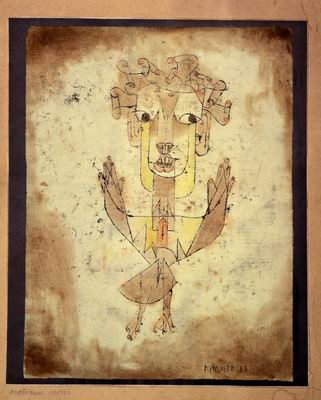
Angelus Novus
As an artist, I know that creation can’t exist without destruction – a painting destroys blank canvas, baking destroys eggs. Just as light can’t exist without darkness, or happiness without sadness. If you can’t feel despair, you can’t know hope.
The opposites always connect, as much as we don’t want them to. I would love to be able to understand pure happiness without having the contrasting experience of sadness, or in my case, clinical depression. When I think about what I would change if I could change anything, I would change my mental illness. I wouldn’t change being non-binary and transgender, the frustrations and late nights of an artist, the stumbling I’m doing as I live on my own for the first time. The darkness I would change vs. the darkness I wouldn’t.
And I think the main difference between the two is that one has an option for an endpoint, for relief, and the other doesn’t. I’m learning how to budget, how to layer, working towards making my body feel like it fits, figuring out an art and life balance. But with my depression, I know that it can always come back. There will always be relapses. There are weeks and months where I take a pill a day and that’s the only time I think about my mental illness. Then there are weeks and months where my medication and therapy and support system and crying on my walk home only reinforces the hopeless feeling.
Today is the first day of Advent – a period of despair followed by a period of hope. At least that’s how we understand it now, in retrospect. We know the story. We see the light. I doubt many of us would change the Advent story. It is a darkness we endure for a promise of the future.
But there’s a difference between hoping and knowing that there is light on the horizon. The Hebrew prophets told of a messiah, but the outcome wasn’t fixed – those experiencing despair didn’t have the stories to fall back on. We have those stories, but I know that I lose faith in them more often than not. Okay, great, in the liturgical year we are acknowledging a space for despair, for mourning, for recognition of violence and oppression, to be followed by the celebration of Christmas. And yet that celebration, instead of bringing light, can highlight the darkness instead.
I still don’t know how to end this testimony. I know that the visceral truth of despair can feel a lot stronger than a hoped-for-hope. That empty words of ‘it will pass’ ‘it gets better’ don’t help with the day-to-day. That stories are sometimes just words on a page. I know how a god-forsaken place feels.
The advent season feels like giving space. To reflect on the darkness we would choose, and to sit with the darkness we wouldn’t. To sit with folks as they wrestle with demons, and loss, and pain. To hope that it is birth pangs and not despair and that simply being present with someone and for someone can be a really radical act of care.
Thank you for giving space this morning.
 Reed Fowler